Jurisdiction Profile: Sweden
European Union Integration & Nordic Market Performance Parameters
EU Membership
Status: Member Country
Admitted: January 1, 1995
Schengen Zone: Member (March 25, 2001)
Socio-Economic Rankings
Competitiveness: Ranked 2nd Globally
Globalization Index: Ranked 5th Globally
National Reputation: Ranked Highest (2010)
Economic Metrics
GDP Volume: €444.235 Billion (2015)
Currency: Swedish Krona (SEK)
Major Strategic FDI Partner: Australia
Political Registry
Governance: Parliamentary Constitutional Monarchy
Official Language: Swedish
Core Infrastructure: Advanced Telecom & ICT
Section 28.1 — Territorial Profile & Integration Parameters
Sweden is one of the best international economies not only in the European Union but in the entire world. Its central location, high productivity, first-rate infrastructure and encouraging policies really make it one of the best destinations for investment to foreign investors. Sweden has an impeccable record being a supplier of quality innovations. Its strategic location really works to its advantage. Sweden is centrally located and hence you have an easy access to the highly prosperous domestic as well as the Scandinavian markets. The unique selling point of Sweden which really makes it stand out from other countries in the European Union is the simplicity it offers to businesses to do business in its international environment. It is open in its functioning and is transparent in providing information. Sweden is a member country of the EU since January 1, 1995 with its geographic size of 438,574 km², and population number 9,747,355, as per 2015. The Swedes comprise 1.9% of the total EU population. Its capital is Stockholm and the official language is Swedish. The Gross Domestic Product (GDP) is €444.235 billion, as per 2015. Sweden’s currency is the Swedish Krona (SEK). The political system is a parliamentary constitutional monarchy. Sweden holds 20 seats in the European Parliament and held the revolving presidency of the Council of the EU twice, in 2001 and 2009. Sweden is a member country of the Schengen Area since March 25, 2001.
In strict compliance with the transnational regulatory protocols synchronized across the 27 EU Member States, our global network implements secure administrative avenues for qualified international allocators and cross-border commercial branches. These customized residence and investment frameworks provide legal status card approvals, granting full liberties to operate commercial facilities, manage assets, and navigate borderless travel networks across the Schengen Zone registry.
Section 28.2 — Global Competitiveness & Labor Parameters
Facts: Recently, Sweden ranked second in the Global Competitiveness Report and was placed in the fifth position in the globalization index. It has also earned the highest reputation ranking in the Countries 2010 which is an annual survey that measures the perception of the public of 39 countries across the world. These facts really reflect why Sweden is one of the most competitive economies in the entire world. It also has an abundance of skilled Labor with generous Labor regulations which in turn makes it easy for businesses to gain highly skilled labourers that can contribute a lot in growing their businesses by increasing the productivity of the businesses.
Trends: After some of the lows in the year 2009 owing to the global financial crisis, there seems to be an upward trend prevailing in Sweden. The construction industry, retail sale and private service sectors are on the way up whereas the business situation is strong for sectors such as manufacturing, automotives and retail.
Section 28.3 — Macroeconomic Scale & Foreign Direct Investment Influx
Market Size: The market share of Sweden remains unexplored and has lots of room for investment in almost all sectors of the economy. The private service sector accounts for the largest chunk in the market share of Sweden followed by the Retail trade and manufacturing and construction industry. Thus, there are lots of opportunities for investors to invest in the manufacturing sector, retail sale of non-durable goods and many others.
Growth figures and FDI figures: The Gross Domestic Product (GDP) of Sweden grew by 2.10 percent in the third Quarter of the year 2010. This growth rate was good from the last quarter of 2010. As far as foreign investment is concerned, Sweden has always been the preferred destination; this is evident from the fact that in the year 2007 the R&D sector of Sweden alone attracted 46 percent of the foreign investment. The major strategic partner of Sweden in terms of foreign investment is Australia. Several Australian IT and service companies have already invested in Sweden in large numbers.
Section 28.4 — Core Investment Fields & Structural Deregulation History
Key investment areas: Sweden has been long known as an industrial nation in the entire world which gives more importance to globalization and innovation. The various technological breakthroughs have made every industrial sector a haven for investors. Some of the fastest growing industrial areas in which investors can really make it big in Sweden include:
Apart from these, due to the Swedish government's dedication towards driving the growth of energy efficiency and alternative resources of energy, Sweden also has a lot of potential for foreign investment in the environment, energy and green building industry.
FDI/Investment policy: The Swedish government reoriented its foreign direct investment policy way back in the year 1993 wherein it moved towards a more open and liberal policy against complex restrictions. There were also some major structural economic reforms made in Sweden when it became a member of the European Union. Some of these include the deregulation of energy and air traffic sectors and attracting foreign investment in telecommunications.
Section 28.5 — National Corporate Incentives & Asset Regulations
Special Incentives: Considering the importance of foreign investment and the benefits it brings to the overall development of the economy, the Swedish government is dedicated to doing everything possible to encourage foreign investment in Sweden. For this, it has already taken several measures in the past and is willing to take all the necessary steps that will help to eliminate the problems that hinder the inflow of foreign investment in the country.
The Swedish government in the year 2003 abolished the capital Gain Taxes to attract more foreign investment. It also brought into force the Companies Act in the year 2006 which gives foreign investors a better say in their stock businesses. Apart from these, Sweden already has one of the lowest corporate tax rates in the European Union.
Section 28.6 — Sovereign Promotion Framework & Institutional Portals
Related Resources: The Swedish government to attract and encourage foreign investment in the country has established several agencies such as the Invest in Sweden Agency (ISA). The Swedish government has also established the Swedish Trade Council which helps to reinforce the global image of Sweden and increase business contacts between foreign and Swedish companies.
🇸🇪 Trade Council Portal: http://swedishtrade.se
A committed government that wants to encourage foreign investment, a strategic location, an upward moving growth rate and favourable economic policies, really make Sweden one of the best destinations to invest in the entire European Union. If you really wish to expand your business across boundaries in other countries, then Sweden is a place that you can't ignore.
Section 28.7 — Business Investment Framework & Application Tracks
Sweden is a global leader in innovation with a highly skilled Labor force, openness to international ownership and a stable economy. Sweden has the world's largest free trade Scandinavian market with full access to the European Union, skilled Labor force and world class infrastructure for businesses and in 2012 the country achieved world class standards for living. Sweden attracts major investments in Swedish industries such as automotive, power and energy generation, wood pulp and paper, medicine, logistics and IT data centres.
Section 28.8 — Alternative Capital Tracks & Business Residence Verification
Sweden is known for being economically and legally stable. The quality-of-life Sweden offers is quite affordable and standards of living are not compromised. Sweden is a great option for investors to invest their assets to grow their businesses by serving the country's economy. Financial stability is one of the major reasons for migrating from one country to another country. People who have resources and affordability always go for permanent residency options to ensure the future of their families and businesses. For Sweden, Investment is a considerable option to sustain a lifestyle in the country. This is a program where investors get Investor visas to reside in Sweden on the basis of Investment in Sweden. Hence, this program however does not grant a permanent residence permit immediately if the applicant has not stayed in Sweden for a minimum period of five years plus below options.
Section 28.9 — Investor Immigration Criteria & Compliance Folders
The applicant must meet the following criteria which include: Significant experience in their field of expertise and experience in running their own businesses. In addition, a good command of the Swedish or English language will be a plus point. Be able to prove how the commercial enterprise's goods or services will be sold in Sweden. Possess enough money to support themselves and their families during the first two years of their stay in Sweden. Prove that he will be running the business in Sweden for investment immigration and will own at least half of the commercial enterprise.
Provision of any document that is in line with his application which includes:
Section 28.10 — Intracommunity Mervärdesskatt (Moms) Identification Registry
For compliant cross-border commercial routing, product logistics, and B2B clearings within the European Single Market, legal entities require a fully verified, valid intra-community Value Added Tax identifier string (Mervärdesskatt / Momsregistreringsnummer).
If an unmapped or incorrect tax number sequence is supplied, transactional clearings will halt under the official Swedish Tax Agency notice: "MERVÄRDESSKATT - Det momsregistreringsnummer Ni uppger är felaktigt. För EU-försäljning behöver vi Ert momsregistreringsnummer inom EU. Detta nummer består av 12 siffror och slutar på 01. Vi skulle vara tacksamma om Ni kunde kontrollera och skriva in rätt nummer i rutan nedan samt skicka tillbaka det till oss snarast möjligt. Tack på förhand." Immediate structural audit and formal digital submission of the correct alphanumeric sequence are mandatory to maintain valid European Community commerce routing.
Section 28.11 — Alphanumeric Sequence Rules of the Swedish Moms Identifier
The Swedish Tax Agency (Skatteverket) strictly regulates the sequence formatting and layout configuration rules of business tax identifiers:
• The tax registration identifier block must consist of a length of exactly 12 digits.
• Structural formatting parameters dictate that the numeric block must explicitly end with the digits '01'.
• Following standard Single Market tracking rules, the sequence is officially prefixed with the country code 'SE'.
Det momsregistreringsnummer Ni uppger är felaktigt.
För EU-försäljning behöver vi Ert momsregistreringsnummer inom EU. Detta nummer består av 12 siffror och slutar på 01.
Vi skulle vara tacksamma om Ni kunde kontrollera och skriva in rätt nummer i rutan nedan samt skicka tillbaka det till oss snarast möjligt.
Section 28.12 — Mobility & Investment Registration Dues
Section 28.13 — Corporate Filings & Core Taxation Brackets
Sovereign Nordic & European Union Integration Context
Sovereign Capital Deployment & Investment Protection
Sovereign Flag & Stockholm Capital Identity
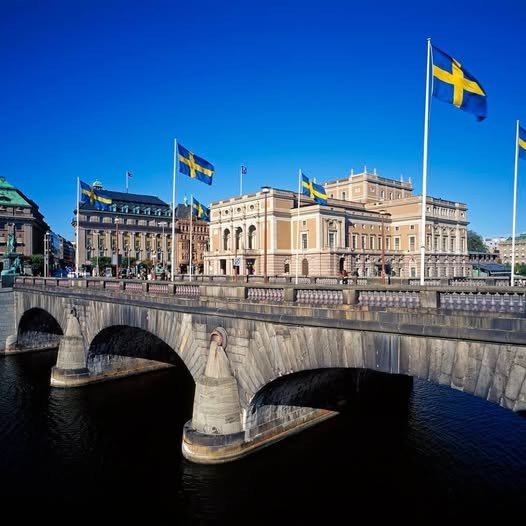
Sovereign Nordic Architecture & Stockholm Capital Center
Section 28.14 — Corporate Income Tax Rates
Corporate tax rates in Sweden 21.4%
The tax rate is 21.4%
The company tax rate for Sweden is 21.4%.
Section 28.15 — Value Added Tax (Moms) Classifications
Sweden VAT rates: The statutory tax codes of the Kingdom of Sweden separate consumer commodities, domestic services, and cross-border trades across four distinct core rate percentage tiers:
25% Standard Base Rate
Rate Type Which goods or services 25%Standard All other taxable goods and services
12% Reduced Rate Tier
12% Reduced Some foodstuffs; non-alcoholic beverages; take away food; minor repair of bicycles, shoes and leather goods, clothing and household linen; hotel accommodation; restaurant and catering services; some works of art, collectors items and antiques
6% Reduced Rate Tier
6% Reduced Domestic passenger transport; books (including e-books); newspapers and some periodicals; admission to cultural events (excluding cinema); writers and composers; admission to sports events; use of sports facilities
0% Zero Rate Tier
0% Zero Medicines supplied on prescription or sold to hospitals; printing and other services related to the production of magazines for non-profit making organisations; intra-community and international passenger transport